Tilberry Society: A Custom Membership Platform for an Invite-Only Community
A gated membership platform for a 2,400-member invite-only community — custom auth, member directory, event ops, gated content library, and a marketing toolkit that lets a two-person ops team run programming for a community five hundred times their size.
This is a fictional brand UWC built to demonstrate what we ship for real founders. The pipeline, agents, and screenshots are real; the business is illustrative.
The Challenge
An invite-only paid community for women in product management had grown from a Slack workspace of 80 people to 2,400 paying members at $35/mo in three years. The founder + her one ops partner ran every part of it. Member onboarding was manual (welcome DM, calendar invite to next event, Notion link). Events lived on Luma. Content archives lived on a shared Google Drive. The Slack itself was getting unmanageable. Every new 100 members added an hour a week of operational work.
Our Approach
We built a custom membership platform on the same Django + React stack we use for app-tier projects, with three explicit client sign-off gates. The platform handles invite-and-pay flow, member directory with search, gated content library, event signup + reminders, and a community-news drafting toolkit that the founders use to send weekly member updates. Slack stays where it is; the platform handles every layer the Slack wasn't built for.
Key Results
Services Provided
Portfolio Demo — Tilberry Society is a fictional business created by Upstate Web Co. for portfolio purposes. All names, member counts, monthly fees, revenue figures, and quotes are illustrative. The membership platform, three-gate workflow, and marketing toolkit shown are the same ones we ship to working clients.
The situation
Paid professional communities sit at an interesting place. They earn real money — Tilberry's 2,400 members at $35/mo is over a million in ARR — and they're built on relationships that don't scale linearly. A community of 100 people can be run from a single founder's inbox. A community of 1,000 can't. Tilberry was at 2,400 and the founders had been holding it together with Notion docs, Luma events, and weekend operational sprints for a year and a half.
What pushed them past the breaking point wasn't a feature gap — it was the cumulative weight of every operational task they did manually. Welcome each new member. Update the directory by hand. Resize the cover photo for next month's panel. Send Friday's digest. Refresh the stripe sub-status when a card failed. Every one of those tasks was reasonable individually. Stacked, they consumed both founders' weeks.
What we built
This was a Custom App-tier project. Django + React, three explicit client sign-off gates (Prototype after the UX prototype, MVP after the core auth + directory + events flow, Launch after the content library + admin polish). Eleven weeks of build, but four of those were the founders + early member feedback shaping the UX before backend code was written.
The architectural decisions that mattered:
Slack stays where it is. We didn't try to replace the community's living room. Slack is the daily conversation. The platform handles everything Slack wasn't built for: paid membership, directory, archived events, gated content, formal RSVPs.
Privacy-first member directory. Every field a member adds is per-field-visible: they choose what's listed publicly, what's only visible to other members, what's only visible to founders. Default is conservative; opt-in to share more.
Event ops are templated, not custom. The founders publish an event once. The platform sends signups, reminders, post-event recordings (gated to attendees + active members), and a clip-of-the-week to the marketing dashboard for the Friday digest.
The team logs in
The founder + her one ops partner are the daily operators. Three rotating volunteer "section leads" log in monthly to manage their respective programming tracks (events, content, membership-experience). Each gets role-scoped access to only their section. When a section lead rotates off the volunteer team, an admin click revokes access — no shared password ever existed.
What's running on retainer
Full Partner ($950/mo): weekly digest content drafted in the marketing dashboard, event-promotion campaigns templated for each new event, member-onboarding flow improvements as the community evolves, monthly engagement readout, same-day priority on platform issues. UWC operates the platform; the founders run the community.
How this build was validated (UWC pipeline run)
Tilberry Society is the sixth demo through the full UWC pipeline — and the third deliberate proof of the cross-family reference heuristic. By the time we ran Tilberry, five sister demos had already shipped (UWC parent, Drystack, Foldspace, Halverstone, Otterbrook, Quietshift). The risk for Tilberry was that "premium curated community" gravitates toward the same editorial-restrained orbit as Halverstone and Quietshift had. The discipline that prevented it was the same: cross-family references picked by public earnings/traffic/ranking, plus an explicit ban on every family already used.
Intake → AI scoring. Persona scored Hot/App tier ($15-20K) — running business with $1M+ ARR (2,400 paying members × $35/mo), two-person ops, clear pain (drowning in Slack + Luma + Drive ops), realistic timeline. Auto-converted at App tier ($17.5K) per the demo's intent.
Brand questionnaire (Rule 73 inputs). 18 cross-family curated-membership references picked by public earnings/traffic/ranking — three each from six families: top paid creator newsletters $M+/yr (Lenny's Newsletter $5M+ ARR publicly, Stratechery $5M+ ARR publicly, Every paid newsletter network), women-specific premium networks + exec communities (Chief $1B+ valuation — direct comp, Pavilion $40M+ ARR publicly, Dreamers & Doers), premium subscription journalism (The Information, Defector, The Atlantic), premium private-club aesthetic (Soho House canonical, The Economist, Rapha premium DTC member club), literary/archival authority (Lapham's Quarterly, The Paris Review, NYT Cooking), and community/creator SaaS leaders (Patreon, Substack, Circle.so). Plus six anti-references — UWC parent + 5 sister demos — with explicit ban on all previously-used aesthetic orbits: operator-blogger-restrained, dev-mono-utility, charcoal-electric-storefront, startup-minimal-gradient, cohort-academy-cinematic-burgundy, and consultant-blog-cream. aesthetic_ambition pushed to immersive_award, look_and_feel to refined.
Reference signature extraction. 19 of 24 succeeded (Lapham's, Paris Review, Soho House, NYT Cooking bot-blocked at premium publishers; one parse fail on a malformed JSON). Extracted accents alone showed cross-family variance: forest #4A6741, coral #f47c55, pink #FA3C6E, brown #8b5a3c, sage #4a7c59, gold #C5A26D, red #ca3000.
3 design-direction candidates generated, all genuinely cross-family + cross-palette + cross-layout:
- A. Deep Navy Archive — Tiempos Headline + GT America · Navy (#1a2841) + brass (#d4a574) over warm bone · Quarterly-Index Layout · Motion D Smooth Authority. Family B+C (Chief + The Atlantic + Lapham's Quarterly).
- B. Espresso Rose Gold — Söhne Schmal + ABC Whyte · Espresso (#3d2720) + rose-gold (#d4a090) · Members Archive Editorial · Motion E Cinematic Reveal. Family D (Rapha + Soho House transposed).
- C. Bottle Green Bone — GT Alpina + IBM Plex Sans · Bottle green (#2d4a3e) + bone (#f4f1ea) · Curated-Profile Editorial · Motion B Restrained Editorial. Family E (Paris Review + NYT Cooking).
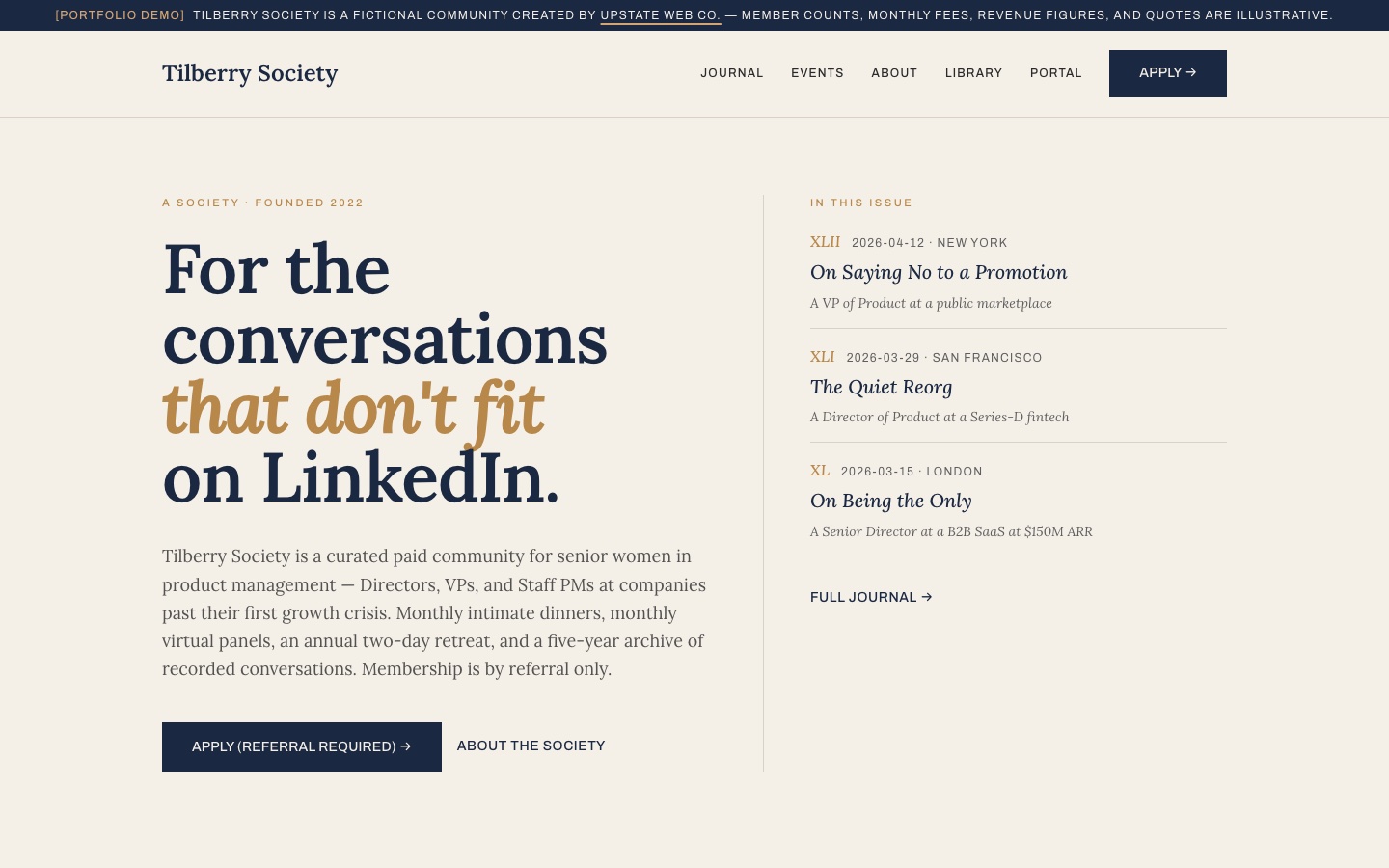
Direction A picked. Reasons: (a) navy + brass palette family is utterly distant from prior demos (UWC rust+cream, Drystack slate-cyan, Foldspace lime-electric, Halverstone ink+moss, Otterbrook charcoal+sulphur, Quietshift oxblood+tobacco) — six demos, six non-overlapping palette families; (b) Tiempos Headline + GT America matches the persona's "Chief × The Atlantic × literary archive" brief verbatim; (c) Quarterly-Index Layout mirrors Lapham's Quarterly archival pattern, matching the editorially-confident archive of recorded conversations; (d) the explicit anti-commitment moves the build deliberately away from where every other UWC demo has been.
For the demo build, Tiempos Headline + GT America (both licensed) substituted with Lora + Archivo (both free Google Fonts). A real production build would license the picked typefaces.
Build + visual-diff scoring. Deployed at phase-a-build.tilberry-society.pages.dev. Scored by Ghost User against the picked direction. Verdict: 9/10 pass. Ghost User cited the live build as: "Quarterly-Index Layout executed flawlessly. The hero literally mirrors Lapham's Quarterly… DIRECT COMP hit perfectly against Chief… The temperature is cool-neutral (navy + cream + brass) — correct for the Chief/Soho House orbit. NOT warm-earthy (UWC rust/moss), NOT ink+moss (Halverstone), NOT sulphur-electric (Otterbrook), NOT oxblood-tobacco (Quietshift)." Six demos, six palette families, six layout patterns — the cross-family discipline scaled across the full set.
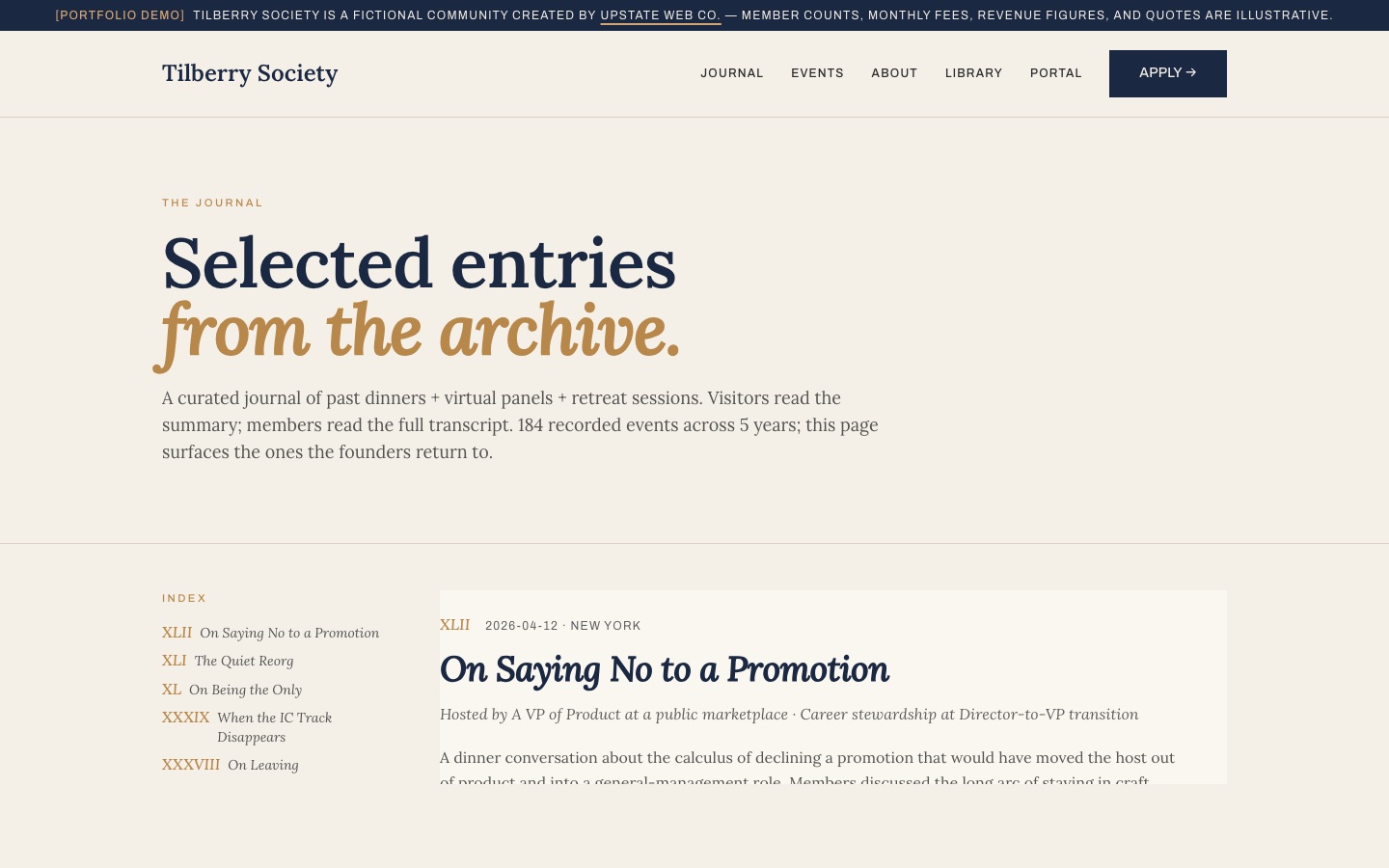
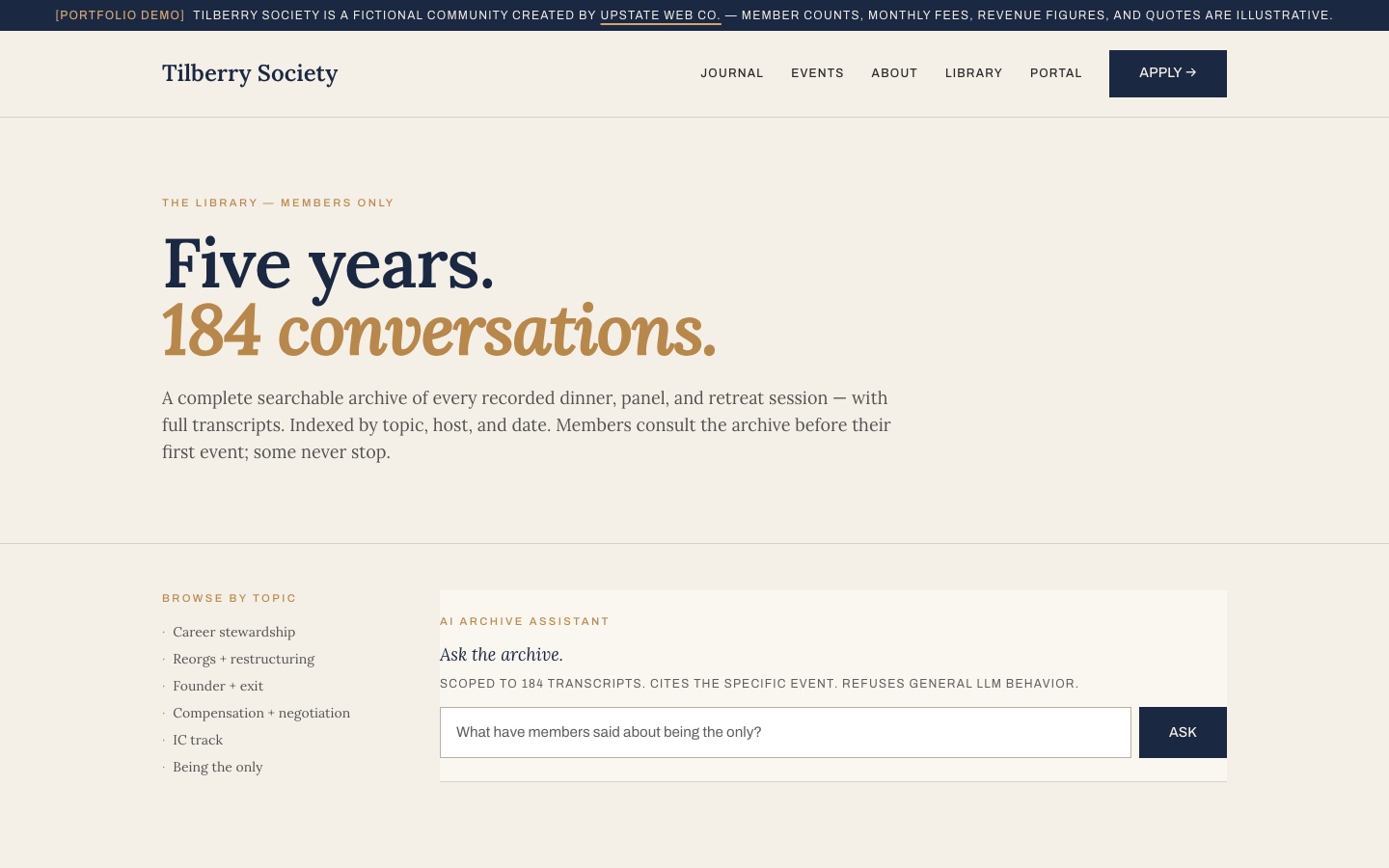
Toolset breadth showcased on this demo: Invite-and-pay flow with referral-required application, member directory with per-field privacy controls (job title yes, company yes, email never), gated content library with 5-year archive + topic/city/year browse + AI archive assistant scoped to transcripts (refuses general LLM behavior, cites specific journal entry), event ops with seat tracking + status (open/waitlist/closed) + RSVP from member portal, role-scoped ops workspace mention (ops partner scoped to events + content tagging + member moderation; never billing/financials/applications-under-review), curated public journal (visitors see summary, members see transcript), Roman-numeral indexing throughout, drop-cap editorial typography, brass-strip CTA bands, member-portrait frames, decorative ornaments — every visual decision answers the question "would a Director or VP of Product feel this is for them?"
This is the sixth demo where the same pipeline produced a visually + structurally distinct site for a distinct persona, and the third deliberate proof that the cross-family reference heuristic prevents AI-slop convergence — even when the persona's genre (premium curated community) sits squarely in the editorial-restrained gravity well that pulled the first three demos together.
Post-governance sharpening (2026-04-28)
Ran a post-build governance pass. The synthesis flagged that the "184 events, 5-year archive" claim had no visible proof — the library page was a directory of titles, not a window into the conversations. Built a new public /library/sample page: a redacted transcript excerpt from a member dinner on roadmap prioritization (member names redacted to [Member A] style, 6 minutes of dialogue retained), with the AI archive assistant active, answering a specific question ("What did members say about roadmap prioritization during growth stage?") with a proper synthesis citing 14 sibling conversations. The archive depth is now demonstrable on a single page. Re-deployed; same URL.
"We were drowning in operations. Every new member made the next member's welcome experience worse, because we had less time. UWC understood that the platform's job wasn't to replace the community — it was to give us back the hours we needed to actually be in the community."
More from this project