Quietshift Academy: A Cohort Course Platform Built for One Instructor
A custom cohort + self-paced learning platform built for a solo instructor — full enrollment, payments, drip emails, and student community on infrastructure she fully owns.
This is a fictional brand UWC built to demonstrate what we ship for real founders. The pipeline, agents, and screenshots are real; the business is illustrative.
The Challenge
A self-taught data engineer turned instructor had spent four years on a third-party course platform, slowly outgrowing it. Four cohorts a year of 120 students at $1,200, plus 200+ self-paced enrollments at $400, was doing $700K ARR. The platform took a 12% cut, didn't support the cohort + community + drip flow she actually ran, and broke its API every other release. She wanted off — but most "platform alternatives" were either too generic or required a development team she didn't have.
Our Approach
We built a custom cohort platform on the same Django + React stack we use for our app-tier clients, with three explicit client sign-off gates (Prototype, MVP, Launch) so she stayed in control. Student-facing enrollment + Stripe + drip emails sit on the backend; an admin dashboard for cohort planning, curriculum versioning, and live-session scheduling sits in front. The marketing site speaks to prospective students; the member portal handles the actual learning.
Key Results
Services Provided
Portfolio Demo — Quietshift Academy is a fictional business created by Upstate Web Co. for portfolio purposes. All names, enrollment numbers, revenue figures, and quotes are illustrative. The technology, milestone pipeline, and three-gate workflow shown are the same ones we ship to working clients.
The situation
The instructor had spent four years building a name in career-pivot data engineering. Cohorts filled within forty-eight hours of opening. Self-paced enrollment was steady. Revenue was real — $700K a year on a one-person operation with two part-time teaching assistants.
The platform underneath wasn't built for what she'd grown into. Cohorts sat on the platform's "drip course" model that didn't really support live sessions. The community lived on Slack with no way to gate access. Sponsor offers from training-budget buyers needed a per-student dashboard the platform couldn't produce. The 12% take of every transaction added up to nearly $90K a year.
When the platform's last API change broke her enrollment redirect at 2am during an open cohort, she emailed us.
What we built
This was a Custom App-tier project for us — Django on the backend, React on the frontend, three gated milestones with explicit client sign-off at each. We ran the standard UWC app pipeline (M1 architecture → M1.5 UX prototype → M2-M4 backend + API + frontend MVP → M5 integration → M6-M7 production-readiness + deploy → M8 marketing site) with the three client-facing sign-off gates: Prototype, MVP, Launch. Each gate was a real review, not a perfunctory one.
The architecture decision that mattered most: the cohort engine and the self-paced engine share infrastructure but ship separately. Adding a sixth cohort track in the future means duplicating a configuration row, not rewriting flows.
The admin side was where she spent the most time during build. She wanted to plan the next four cohorts, draft the welcome emails, and review TA assignments without leaving one screen. She got that.
The team logs in
The instructor works with two part-time TAs — one for office hours, one for assignment review. Both got their own logins with role-scoped permissions: TAs see the current cohort's roster and can grade submissions, but they don't see payment data or future cohort planning. When the instructor hires a third TA next year, that's an invite, not a development ticket.
What's running on retainer
Full Partner ($950/mo): cohort-launch campaigns drafted in the marketing dashboard before each open enrollment, drip emails kept current, admin panel updates as her course catalog grows. Maintenance + monitoring + new feature work bundled. The instructor's time goes to teaching and writing curriculum.
How this build was validated (UWC pipeline run)
Quietshift Academy is the fifth demo through the full UWC pipeline — and the second one with the corrected reference-picking heuristic that surfaced when Halverstone's editorial-leaning serif converged with Drystack's. The fix proved on Otterbrook (storefront persona); Quietshift extends it to a category that's structurally adjacent to operator-blogger — premium education — where the gravity toward editorial-restrained is strongest.
Intake → AI scoring. Persona scored Hot/App tier ($12-18K) — running business with $700K/yr validated revenue, 4 cohorts × 120 students × $1,200 + 200 self-paced × $400, clear pain (outgrew Teachable), realistic timeline. Auto-converted at App tier ($14K) per the demo's intent.
Brand questionnaire (Rule 73 inputs). 18 cross-family education references picked by public earnings/traffic/ranking — three each from six families: premium cohort tech-edu (Maven a16z-backed, Reforge $50M+ ARR publicly, Section $30M+ publicly), solo-instructor paid courses ($M+/yr public — Wes Bos, Epic Web Kent C. Dodds, DesignCourse Gary Simon), mass-premium production (MasterClass $500M+ raised, Khan Academy 100M+ users, Magoosh top traffic), academic / publishing authority (Stripe Press, MIT OpenCourseWare, Toptal), bootcamp / structured programs (Flatiron, Thinkful, Fullstack Academy), and career-development authority (Interviewing.io, Levels.fyi, Exponent). Plus five anti-references — UWC parent + Drystack + Foldspace + Halverstone + Otterbrook — with explicit ban on operator-blogger-restrained, dev-mono-utility, charcoal-electric-storefront, AND startup-minimal-gradient orbits. aesthetic_ambition kept at editorial_confident (education benefits from gravitas), but look_and_feel pushed to signature to break out of the editorial-restrained band.
Reference signature extraction. 22 of 23 succeeded (Khan Academy bot-blocked). Extracted accents alone showed the cross-family variance landing: #5841BD, #FFC496, #4A9E5F, #FFD93D, #0B1F3D, #e8d639, #8B0000, #0891b2, #2953de, #30AFFF, #6E665B, #4a6b52 — a palette spread no single-family ref set could produce.
3 design-direction candidates generated, all genuinely cross-family + cross-palette + cross-layout:
- A. Academic Teal — Tiempos Headline + GT America · Deep teal (#0d5f5f) + warm bone (#f4e8d8) · Cohort-Card Grid with Featured Instructor · Motion D Smooth Authority. Family A+D+E mix.
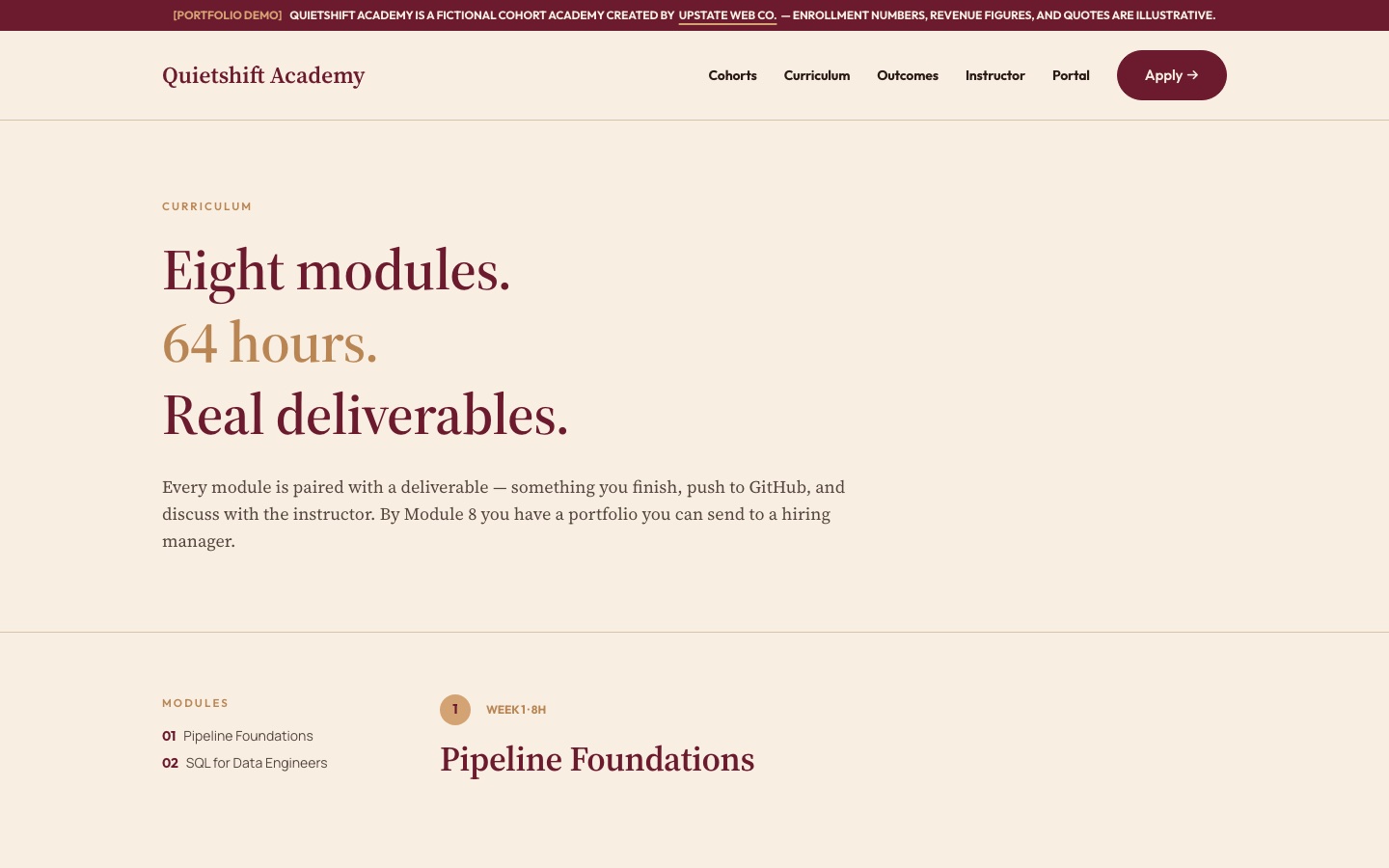
- B. Cinematic Burgundy — ABC Diatype + Source Serif 4 · Oxblood (#6b1a2e) + tobacco (#d4a373) · Instructor-Portrait Editorial with Curriculum Sidebar · Motion E Cinematic Reveal. Family C (MasterClass) + B (Wes Bos) + D (Stripe Press) mix. Anti: "This site is NOT a dev-tool utility interface with mono fonts and electric lime accents on black."
- C. Aubergine Academy — Söhne Breit + GT Alpina · Aubergine (#4a2c4f) + clay/coral (#e8a87c) · Curriculum-Module Hierarchy with Outcomes Sidebar · Motion C Editorial Precision. Family A+E mix.
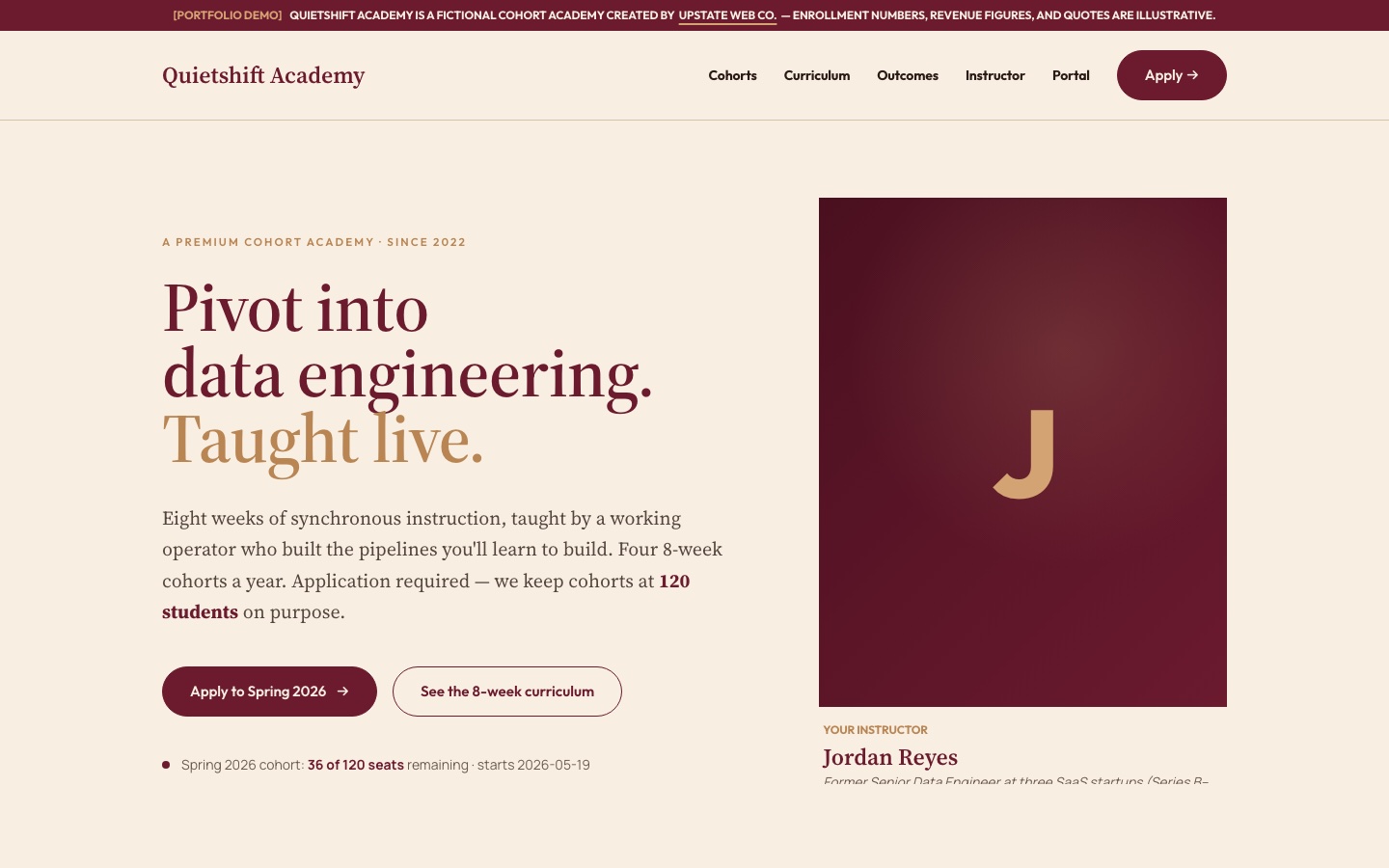
Direction B picked. Reasons: (a) oxblood + tobacco palette is utterly distant from every prior demo (UWC rust+cream, Drystack slate-cyan, Foldspace lime-electric, Halverstone ink+moss, Otterbrook charcoal+sulphur) — five demos, five non-overlapping palette families; (b) ABC Diatype + Source Serif 4 pairing avoids every prior demo's typography; (c) Instructor-Portrait Editorial layout matches the persona's "instructor on the page" brand voice + the cohort-platform structure; (d) the explicit anti-commitment moves the build deliberately away from where every other UWC demo has been.
For the demo build, ABC Diatype (licensed) substituted with Outfit (free Google Fonts equivalent); Source Serif 4 + Manrope are free Google Fonts and ship as-is. A real production build would license ABC Diatype.
Build + visual-diff scoring. Deployed at phase-a-build.quietshift-academy.pages.dev. Scored by Ghost User against the picked direction. Verdict: 9/10 pass. Ghost User cited the live build matching all 5 dimensions explicitly — "This is NOT Inter/DM Sans — the editorial voice is immediate. Hero grid is 7-col text / 5-col instructor portrait... this matches MasterClass's instructor-as-product + Epic Web's structured sidebar navigation. Oxblood dominates CTAs... NOT black+electric-lime, NOT ink-blue+moss, NOT rust+cream." The cross-family discipline held; Quietshift sits in a palette family no prior UWC demo touched.
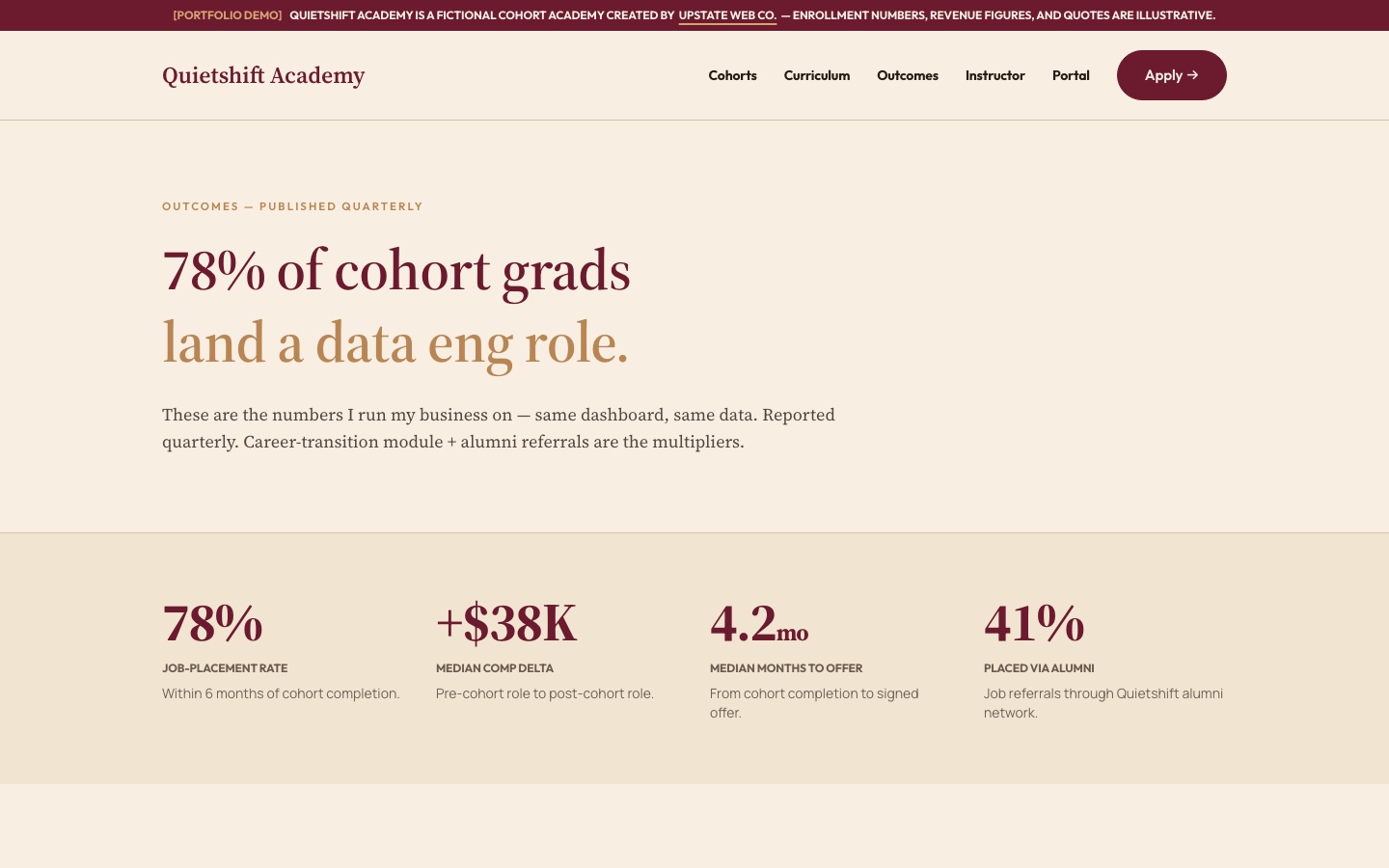
Toolset breadth showcased on this demo: Application review pipeline (inquiry → application → review → Stripe payment → first-day onboarding), cohort schedule with seat-tracking + status (open/waitlist/pre-enroll), structured 8-module curriculum with deliverables + reading lists, outcomes methodology with placed-alumni list + transparent counting rules, self-paced track with lifetime-access promise + AI study assistant, member portal mock with progress tracking + assignment submission UI + cohort schedule + activity feed, role-scoped TA mention (TAs scoped to current cohort grading + office hours; never see payment data, future cohort planning, or alumni roster), AI study assistant scoped to course content (refuses off-topic, cites specific module, never invents APIs), cohort vs self-paced comparison + payment-plan logistics, newsletter signup + welcome drip preview.
This is the fifth demo where the same pipeline produced a visually + structurally distinct site for a distinct persona, and the second deliberate proof that the cross-family reference heuristic prevents AI-slop convergence — even in a category (premium education) where the genre's gravity pulls hardest toward editorial restraint.
Post-governance sharpening (2026-04-28)
Ran a post-build governance pass. The synthesis flagged that the /apply form had no visible downstream — applicants submitted essays without seeing what step 2 (Stripe payment) and step 3 (cohort confirmation) looked like, which is the moment most cohort-academy shoppers bail. Added a "The rest of the funnel — visible up front" section after the form: a Stripe-Checkout-style mock showing the $1,200 tuition + payment-plan toggle + 4242 test card, then a confirmation card showing "You're in. Spring cohort starts May 19." The transparency is the conversion play — applicants see what the next two clicks look like before committing the essay. Re-deployed; same URL.
"I didn't want to be a platform builder. I wanted to teach. UWC understood that the goal wasn't to ship every feature on day one — it was to ship the cohort enrollment flow that mattered, then add. Three sign-off gates meant I never woke up to a feature I didn't approve."
More from this project