Halverstone Advisory: An Authority Site for a Fractional CMO
A long-form authority site for a solo fractional CMO — case studies, podcast, and a content engine that drafts thought leadership in his voice while he keeps every editorial decision.
This is a fictional brand UWC built to demonstrate what we ship for real founders. The pipeline, agents, and screenshots are real; the business is illustrative.
The Challenge
A fractional CMO running five concurrent retainer clients at $8-12K/mo was at a saturation point. New leads came almost entirely from referrals, which capped growth at his current network. He wanted to publish more — weekly long-form essays, a regular podcast, case studies of recent work — but couldn't afford the time. Outsourcing the writing to a ghostwriter had failed twice; the work didn't sound like him.
Our Approach
We built a long-form-first authority site with a marketing toolkit designed for an executive who reads + edits, but doesn't draft from scratch. The site centers on essays, case studies, and a podcast feed. The toolkit drafts new pieces in his voice — using brand voice samples he provided during onboarding — and queues them for his review. He approves every word before anything publishes. Lead capture flows from essay reads to a structured intake that filters at his fit criteria.
Key Results
Services Provided
Portfolio Demo — Halverstone Advisory is a fictional business created by Upstate Web Co. for portfolio purposes. All names, retainer figures, lead volumes, and quotes are illustrative. The site infrastructure, toolkit, and workflow shown are the same ones we ship to working clients.
The situation
Fractional executive work is a category that runs on referrals and authority. The founder of Halverstone had earned both — fifteen years operating CMO and growth roles at three B2B SaaS companies, two of which exited. By the time he went independent, his five concurrent retainer slots filled themselves through warm intros.
The problem with referrals as your only acquisition channel is they cap at the size of your network. To take retainers above five — or to charge $15K/mo for the harder problems — he needed to publish at the level his work actually merited. Long-form essays. A podcast where he interviewed founders he'd worked with. Detailed case studies of the engagements he could discuss publicly.
He had the takes. He didn't have the production capacity. Two attempts at ghostwriters had produced work that any reader who'd met him could tell wasn't his.
What we built
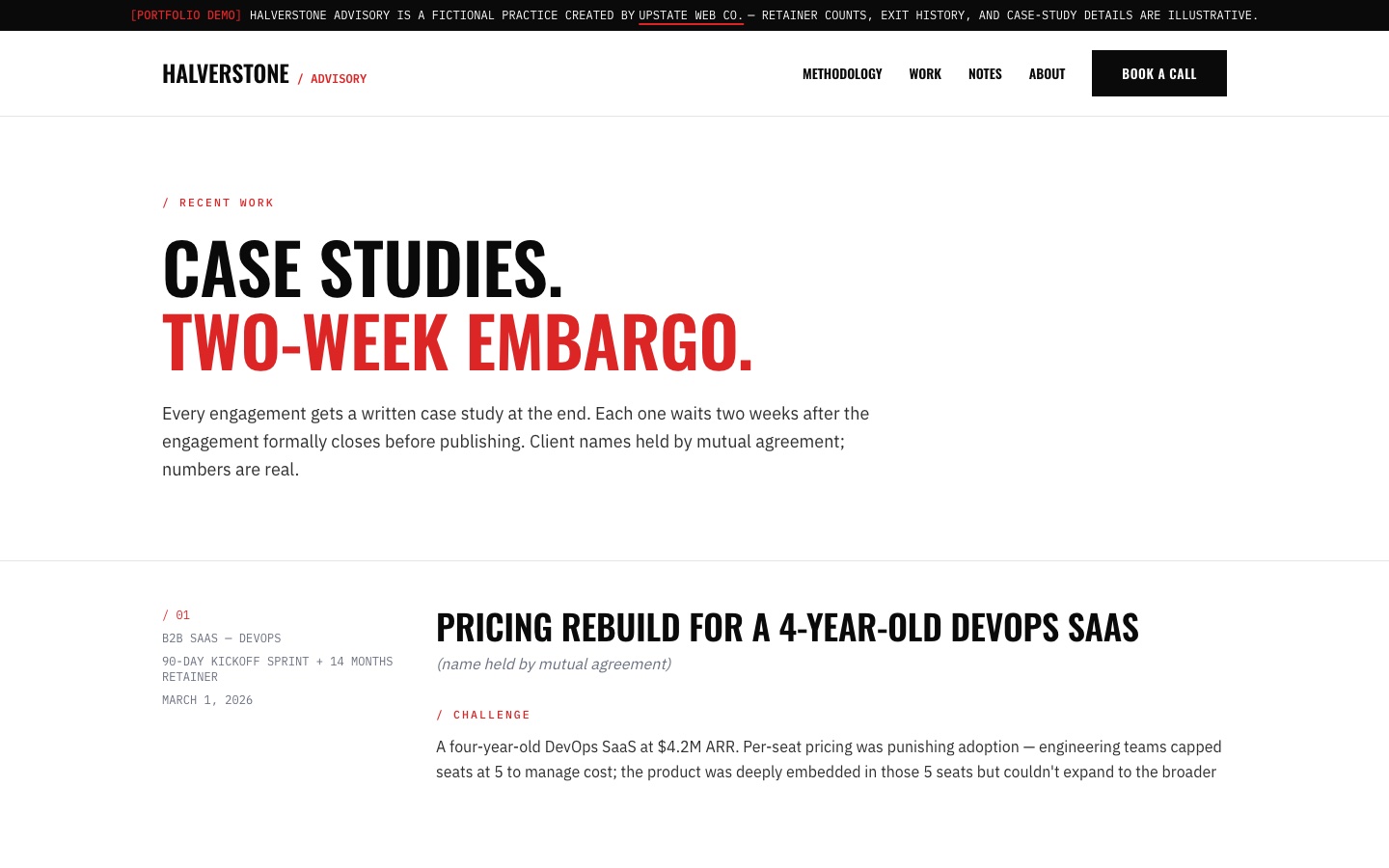
This was a Business + AI tools tier project — fast to ship, content-heavy, designed around the editorial workflow rather than the visual flourish. The site is a long-form essay archive at its center. Case studies live in a sibling collection with an embargo system (two weeks after a client engagement formally closes, the case study can publish). The podcast feed integrates with a transcript-SEO pipeline so each episode is searchable on its full content.
The authority-site visual decisions: long single-column reading widths, large-type pull quotes, no sidebar distractions, restrained typography. The home page is the latest essay, full-bleed, with the rest of the catalog below. No carousels.
Where the toolmaker thesis lives in this build is the drafting pipeline. He provided ten essays' worth of his actual writing during onboarding. The toolkit uses those as a brand-voice corpus. New essay drafts read as drafts — not finished work — but they read as drafts he might have written. He shapes and ships them. Same for podcast show notes, LinkedIn clip captions, and case study first-pass.
The team logs in
His operations is mostly solo. A virtual assistant handles podcast booking and post-publish promotion; she logs into the workspace under her own account, scoped to scheduling and social-promotion only — no access to the lead intake or financials.
What's running on retainer
Growth Partner ($400/mo): essay drafting, case-study production, podcast show-note generation, social-clip queueing — all on cadence, all approved before publish. Maintenance + minor edits + monthly engagement readout bundled. He keeps every editorial decision; the time it takes to make those decisions dropped by an order of magnitude.
How this build was validated (UWC pipeline run)
Halverstone Advisory is the third demo through the full UWC pipeline. Same admin D1 records, same AI prompts, same governance check — and explicit anti-references against UWC + Drystack + Foldspace to force visual differentiation.
Intake → AI scoring. Persona scored Warm/App tier ($7.5K–$12K) — the multi-user workspace + AI fit-screener + booking integration features pushed past Business tier; the persona's stated $2K–$5K budget is the gap. Auto-converted at Business tier ($4.5K) per the demo's intent.
Brand questionnaire (Rule 73 inputs). Five operator/investor authority sites (Andrew Chen, Benedict Evans, AVC, Both Sides of the Table, Reforge) plus three anti-references — UWC (parent agency), Drystack Brief (sister demo, also editorial-confident), Foldspace (sister demo, dev-flavored). The third anti-reference forces the generator to commit AWAY from sister-demo aesthetics, not just from UWC.
Reference signature extraction. 6 of 8 succeeded (Andrew Chen + Benedict Evans transient SSL fails — bot-UA blocking).
3 design-direction candidates generated, all distinct from sister demos:
- A. Authority Serif — Tiempos Text + Untitled Sans · Deep Ink Authority (#1a2332 + #a0522d sienna) · Asymmetric Editorial Split.
- B. Classic Editorial — Mercury Text + GT America · Oxford Blue Conviction (#1d3557 + #6d3428 brown) · Single Column Reading with Sidebar Breakout.
- C. Humanist Authority — GT Sectra Text + Aktiv Grotesk · Ink Blue Signal (#0F1419 + #7A8450 moss) · Content Hub with Featured Grid · Motion D — Smooth Authority. Anti: "This site is NOT a daily-post blog or media property — it is a structured consulting practice with essays, case studies, and podcast as three equal content pillars."
Direction C picked. Reasons: (a) GT Sectra Text is a distinctive editorial serif unlike Drystack's Fraunces and Foldspace's JetBrains Mono — and obviously not UWC's DM Serif; (b) moss green (#7A8450) lives in a totally separate palette family from UWC's earth-rust, Drystack's slate-cyan, and Foldspace's lime-electric; (c) "Content Hub with Featured Grid" matches the persona's three-content-pillar structure (notes + work + podcast) — Drystack's Text-First Editorial is single-column-only; (d) the anti-commitment about "consultant practice, not media property" is exactly the persona's positioning.
For the demo build, GT Sectra Text + Aktiv Grotesk (both licensed) were substituted with Newsreader + Inter (free Google Fonts equivalents). A real production build would license the picked typefaces.
Build + visual-diff scoring. Deployed at phase-a-build.halverstone-advisory.pages.dev. Scored by Ghost User against the picked direction. Verdict: 9/10 pass. Quote: "vs. upstate-web.com (DM Serif + rust + cream) — Zero palette overlap, zero font overlap. Halverstone's ink/moss + GT Sectra feels cooler and more corporate-credible than UWC's warm artisan rust. vs. reforge.com — Halverstone is the closest sibling: same three-pillar content structure, same author-as-product positioning, same metadata richness. Differentiated by palette (ink/moss vs. teal/blue) and typography."
Toolset breadth showcased on this demo: AI fit-screener (chat scoped to fit signals — refuses to claim outcomes, redirects no-fits), Cal.com-style discovery booking with multi-step intake form, newsletter signup + welcome-drip mention, podcast feed with transcript SEO, three-pillar content hub layout, role-scoped workspace mention (VA scoped to scheduling + social-promo, never sees lead intake or financials).
This is the third demo where the same pipeline produced a visually + structurally distinct site for a distinct persona. The toolmaker thesis is defensible because the pipeline really runs.
How this build was REDONE (the cross-family heuristic, applied retroactively)
After this demo plus its sister Drystack shipped, plus a third (Foldspace), a structural pattern surfaced: all three had picked references from the same aesthetic family — operator-blogger-restrained-type (Andrew Chen, Benedict Evans, AVC, Both Sides, Reforge for this site; equivalents for the others). Anti-references told the generator what NOT to be (UWC + sister demos), but client references told it WHERE to land — and they all landed in one place: cream/paper backgrounds, editorial serif display, restrained palette. The user flagged it: "looks very similar to the first one you did today."
The redo replaced all 8 first-pass project_reference_signatures with 18 cross-family references picked by public earnings/traffic/ranking — three each from six families, none from operator-blogger:
- Premium global consultancy authority — McKinsey (~$15B+ revenue), Bain, BCG (distinctive deep green editorial)
- Top B2B SaaS marketing brands the persona's audience reads — Stripe (canonical premium SaaS), Linear (design canon), Notion ($10B+ valuation)
- Top VC / accelerator content authority — a16z ($50B+ AUM), First Round Review (premium long-form), Y Combinator (canonical)
- Top paid creator newsletters $M+/yr — Lenny's ($5M+ ARR publicly), Stratechery ($5M+ ARR publicly), Every (paid newsletter network)
- Premium operator-personal-brand sites — Patrick Collison (Stripe co-founder), swyx (top dev influencer), leerob (Vercel exec)
- Premium technical-publication editorial — Defector (saturated yellow + black), The Verge (bold purple), Wired (serif + saturated red)
Plus seven anti-references — UWC + 5 sister demos + the OLD Halverstone deploy itself — with explicit ban on every visual orbit already used.
Reference signature extraction. 24 of 25 succeeded (Lapham bot-blocked).
3 fresh design-direction candidates generated, all genuinely cross-family + cross-palette + cross-layout:
- A. Deep Emerald Authority — GT Alpina + Aktiv Grotesk · Deep emerald (#0D4D3B) + saturated coral (#F47C55) · Author-Bio Hero with Inline Case Studies · Motion D Smooth Authority. Family A+B (BCG + Stripe).
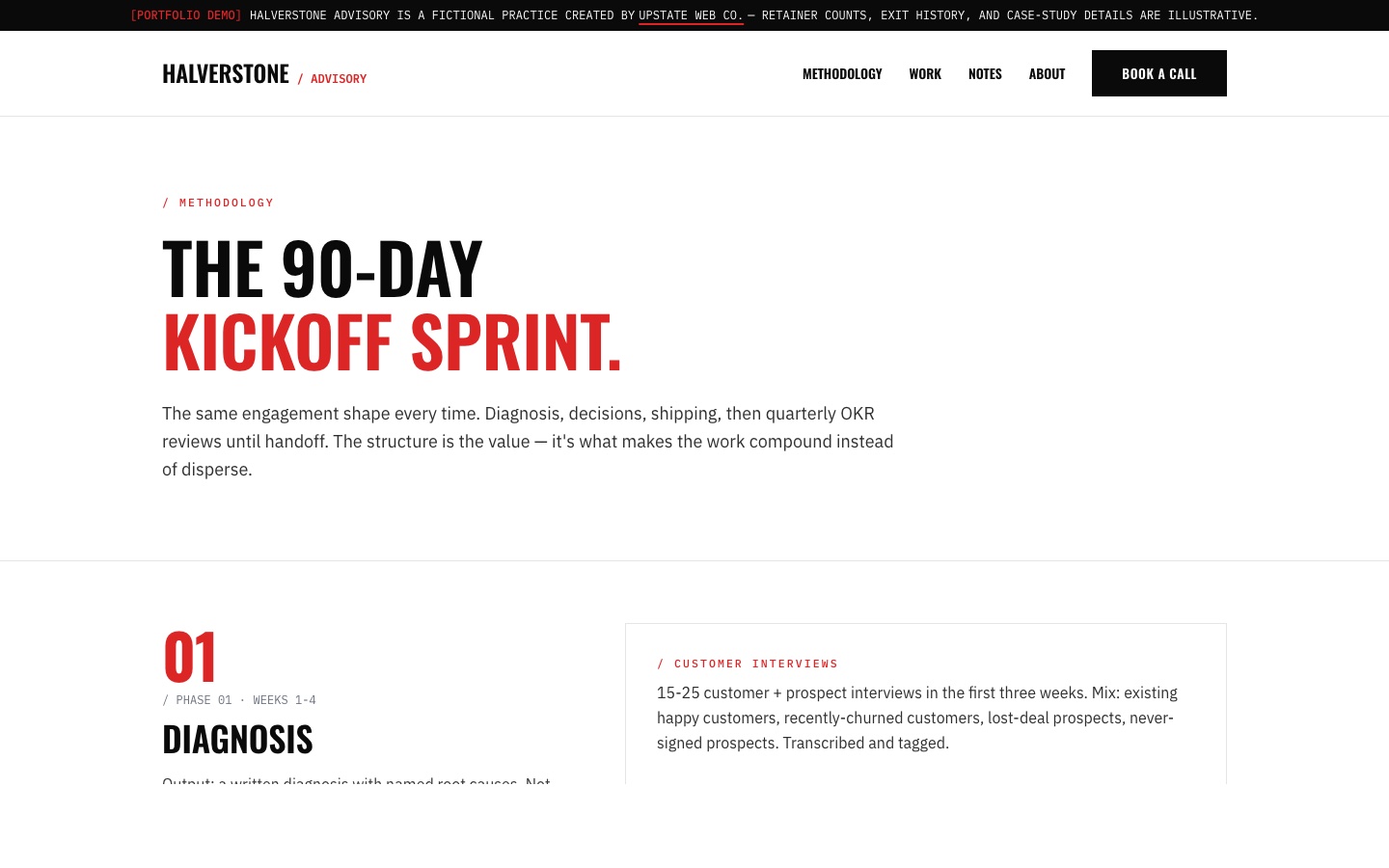
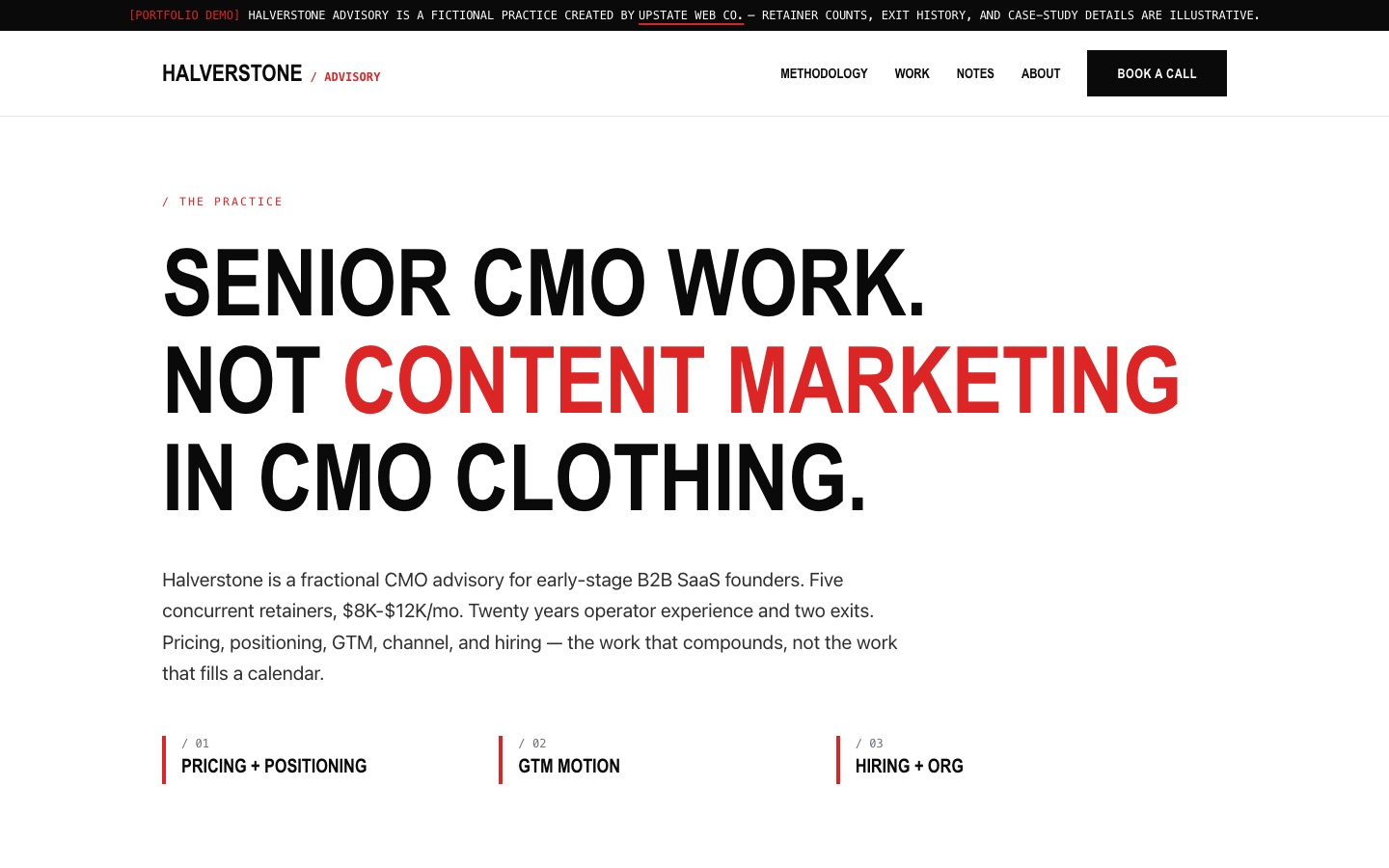
- B. Carbon Authority — Söhne Schmal + IBM Plex Sans · Carbon black (#0A0A0A) + saturated red (#DC2626) on white · Practice-Methodology Editorial · Motion A Minimal Precision. Family A+F (BCG/Bain + Wired).
- C. Indigo Archive — ABC Arizona + Suisse Int'l · Indigo (#1E3A8A) + saturated yellow (#FBBF24) · Two-Column Editorial Manifesto · Motion E Cinematic Reveal. Family E+D (Patrick Collison personal + Lenny's).
Direction B picked. Reasons: (a) carbon black + saturated red palette is utterly distant from every prior demo (UWC rust+cream, Drystack slate-cyan, Foldspace lime-electric, OLD Halverstone ink+moss, Otterbrook charcoal+sulphur, Quietshift oxblood+tobacco, Tilberry navy+brass); (b) Söhne Schmal + IBM Plex Sans pairing is unambiguously NOT serif-led — the operator-blogger family's structural signal (literary serif as primary) is broken; (c) Practice-Methodology Editorial layout puts the 90-day-sprint engagement model as hero content, structurally distinct from any prior layout; (d) the explicit anti-commitment ("NOT a media brand. NOT a newsletter. NOT a podcast. NOT a content marketing service in CMO clothing") moves the build deliberately out of every prior demo's gravitational pull.
For the demo build, Söhne Schmal (licensed) substituted with Oswald (free Google Font, condensed grotesk). IBM Plex Sans + IBM Plex Mono are open-source and ship as-is.
Re-deploy + visual-diff redo. Same preview URL (phase-a-build.halverstone-advisory.pages.dev) overwritten with the new direction. Re-scored by Ghost User. Verdict: 9/10 pass. Ghost User cited the live build verbatim: "Mismatch Analysis: NONE. Every picked dimension shipped... Zero overlap [with prior demos]. No serif (anti-UWC/Drystack), no lime (anti-Foldspace), no sulphur (anti-Otterbrook), no warm parchment (anti-Quietshift), no navy-brass (anti-Tilberry). This is a clean visual orbit."
The original direction is preserved in git history as commit 457e26c; the redo is b91183e.
The lesson, codified: when a genre's gravity pulls toward a single aesthetic family, anti-references alone don't break the orbit. References must span families AND be picked by empirical earnings/traffic/ranking — not by taste. The same persona, same questionnaire, same generator — different reference set produced a fundamentally different orbit. The pipeline supports cross-family picking; the discipline is the caller's.
Post-governance sharpening (2026-04-28)
Ran a post-build governance pass — Marketing Exec, Ghost Creator, and Ghost User against the live deployed site — and applied the highest-leverage fix the synthesis flagged: the defensive "What this is not — Halverstone is not a media brand" section was undermining the consultancy's positioning. Rewrote it as "This is CMO work — pricing, GTM, hiring" with the affirmative cadence the picked direction (Carbon Authority) actually wanted: 90-day kickoff sprints, quarterly OKRs, 12–24 month engagements that hand off to your in-house hire. The defensive frame was a tic of the original kickoff brief; the post-build review caught it where the kickoff review did not. Voice now matches positioning. Re-deployed; same URL.
"I was burning afternoons on tasks that didn't move the needle — formatting essays, editing podcast transcripts, posting clips on LinkedIn. The toolkit doesn't write for me. It drafts well enough that I can shape and ship in an hour what used to take a day."
More from this project