Hale Industrial — AI Workbench for real estate acquisitions
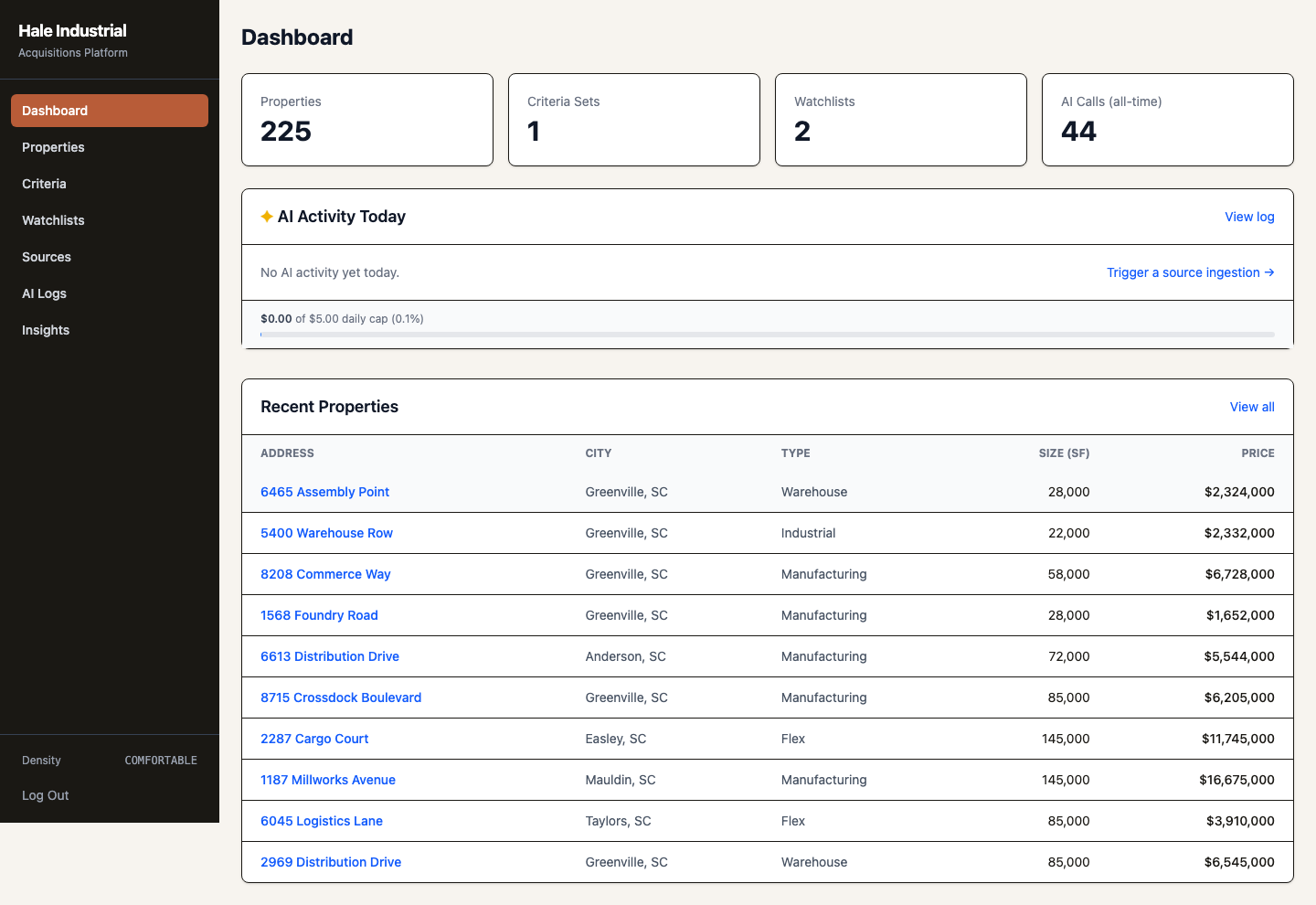
A workbench for a CRE acquisitions firm. Ingest listings from web scrapes, PDFs, and broker email. Extract structured fields with Claude. Score every property against a tunable buy-box. Draft broker outreach the analyst signs and sends — never autosent. One ranked list, daily.
Visit the siteThe Challenge
A small industrial acquisitions firm drowning in broker email, LoopNet PDFs, and three separate listing sites. Every morning the team spent an hour re-reading the same listings trying to remember who they'd already contacted and which deals still fit the buy-box. The manual workflow meant good deals slipped past — surfacing only after a competitor had already made an offer. They didn't need another CRM. They needed one ranked list that arrived every morning with the reading already done.
Our Approach
We built Hale Industrial as an AI Workbench — a workflow-specific application for one specialist role (the acquisitions analyst) rather than a general- purpose tool. Pipeline: ingest listings from multiple sources → extract structured fields with Claude (address, size, clear height, docks, asking price, broker) → score against named search criteria with tunable weights → surface a ranked list with transparent per-factor breakdown → AI drafts broker outreach emails the analyst reviews, edits, and sends from their own inbox. No autosend. No black-box scoring. A daily AI cost ceiling so a bug can never burn the budget. Per-tenant data isolation from day one so the architecture can scale if the model proves out.
Key Results
Services Provided
Hale Industrial is a workbench for one job: industrial CRE acquisitions. Not a CRM. Not a database. Not a chatbot. A tool the firm's analyst opens every morning to see one ranked list — with the tedious reading, scoring, and drafting already done.
The workflow
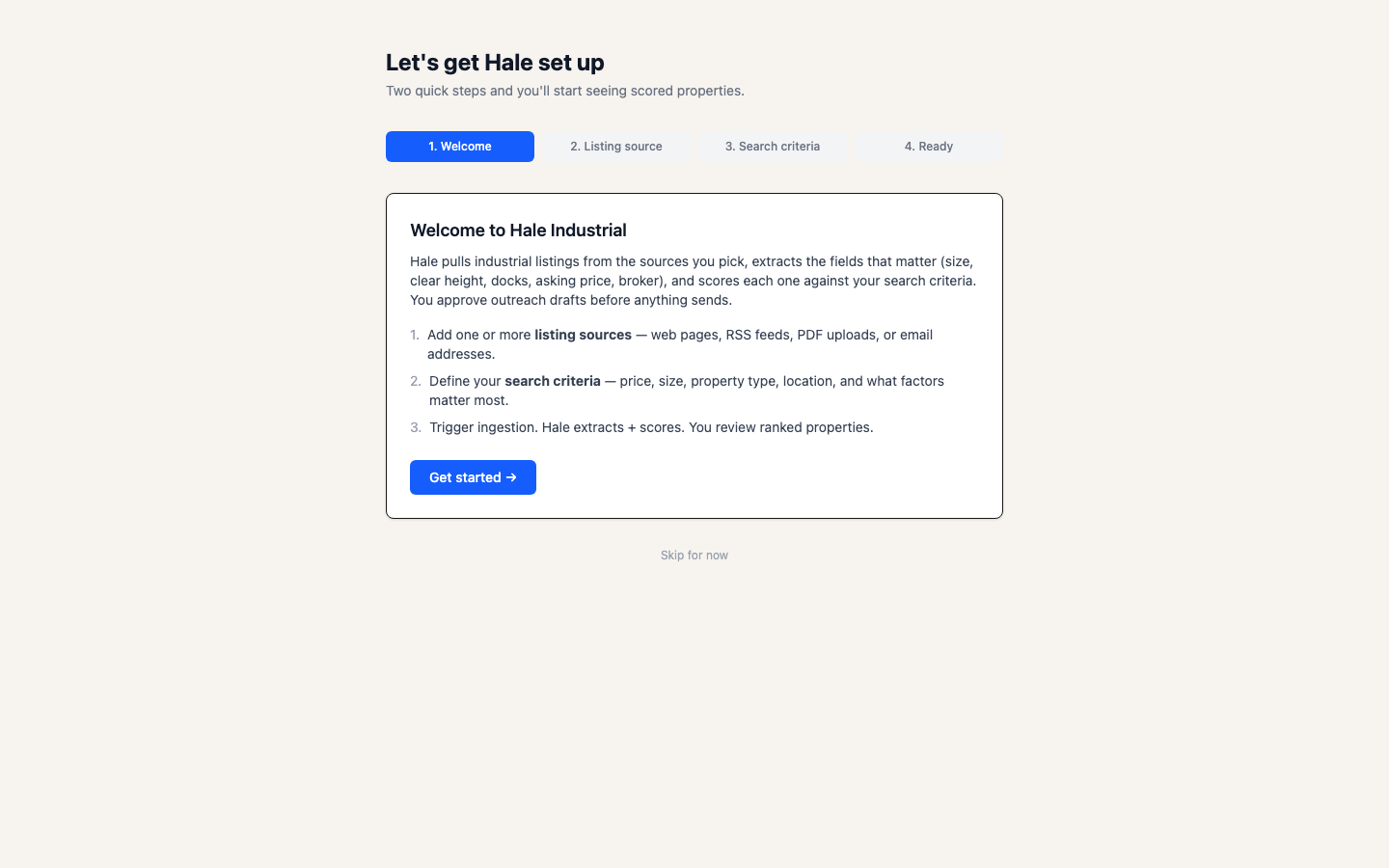
Ingest. Point Hale at a LoopNet page, a broker email inbox, a PDF folder of brochures, or an RSS feed. Each source runs on its own schedule — hourly, daily, weekly, or manual-trigger-only. Raw listings arrive as text; Hale archives the source alongside the structured row so you can always cross-check.
Extract. Claude reads each listing and pulls structured fields: address, property type, size, clear height, loading docks, asking price, cap rate, broker contact. Every extraction gets a confidence score (0–100%). Under 75% goes to human review before entering the ranked list.
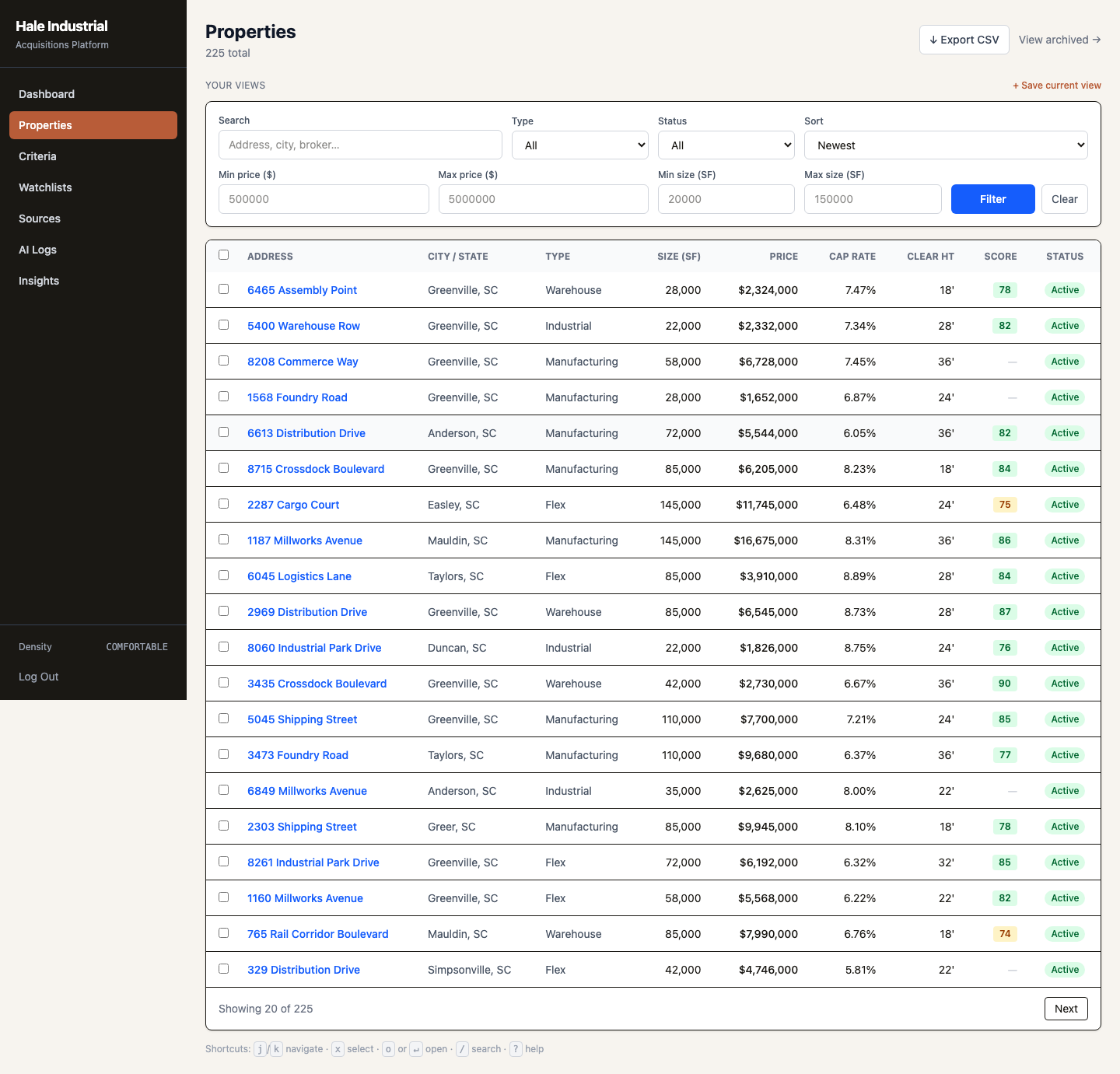
Score. You define your buy box as a named search criteria — property types, size range, price ceiling, clear-height floor, location, rail access. You assign relative weights to each factor. Every property gets a 0–100 score with a per-factor breakdown visible on the card. The math is transparent weighted sum, not a learned black-box ranker. You can always answer "why is this #1?" in a partner meeting.
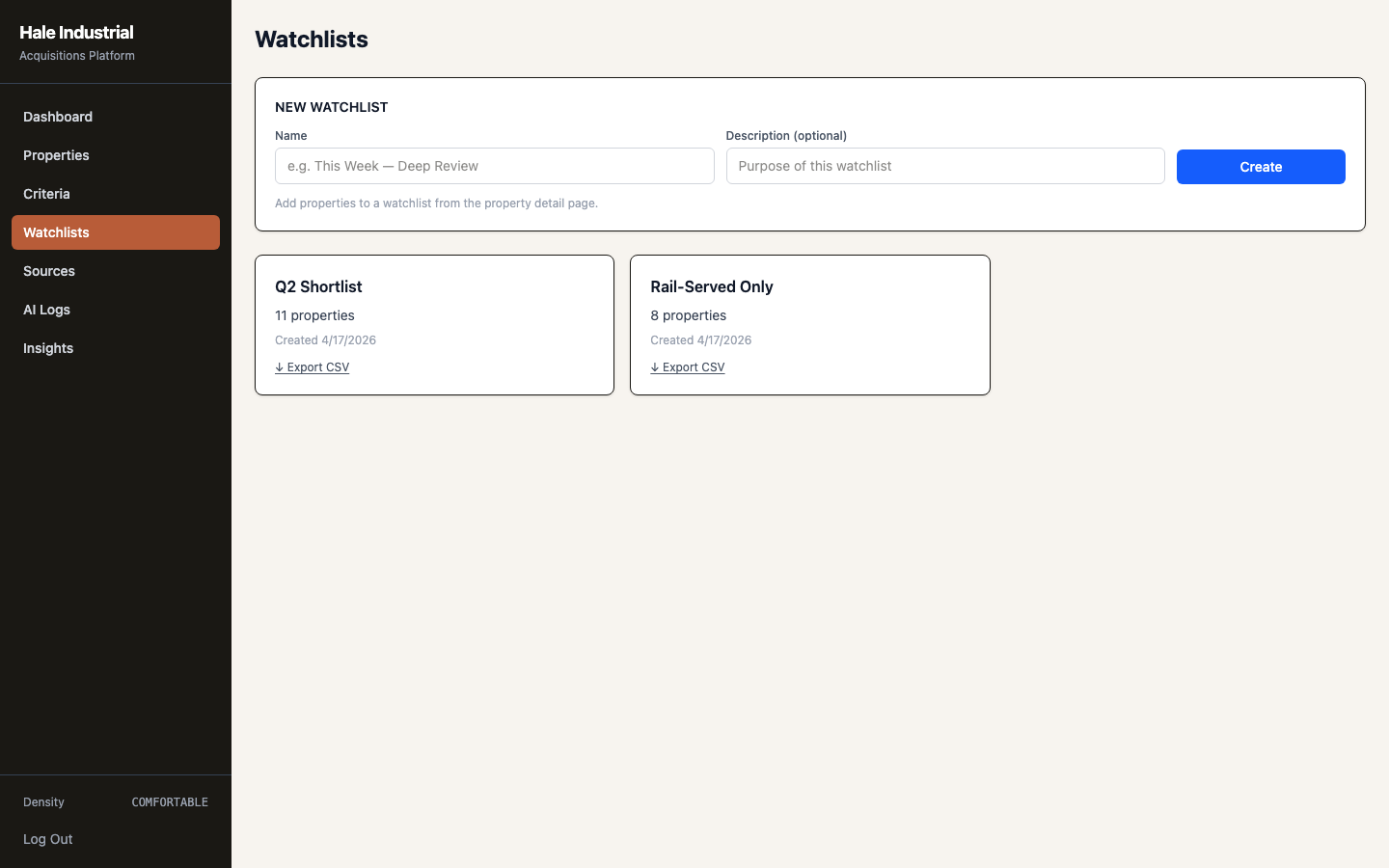
Surface. A single ranked list, daily. Filter by price, size, state, clear height. Bulk-select to add to a watchlist, change status, or archive. Export to CSV for partner calls. Sort by confidence, score, price, or recency.
Draft. On any property, click "Draft Email." Claude writes a short first-pass broker email in the tone you pick — professional, direct, warm, or follow-up. You edit, copy to clipboard, and send from your own email. Hale never sends on your behalf. Your reputation stays tied to your address. Mark the outreach sent; next draft to the same broker knows you've already reached out.
What Hale explicitly does NOT do
The scope was drawn deliberately narrow. We pushed back on every ask that widened it.
- Does not send email on the user's behalf. Autosend was requested, rejected, and will stay rejected. The human signs every outreach.
- Does not decide offer prices. Hale shows asking price and cap rate; everything past that is the analyst's judgment.
- Does not integrate with CRMs or closing platforms. The tool ends at "I wrote you a draft" — downstream deal-flow lives in whatever tool the firm already uses.
- Does not sell or share your data. Per-tenant isolation at the data layer AND the AI-cost layer. Your listings, scores, notes, and drafts are visible only to your tenant.
Under the hood
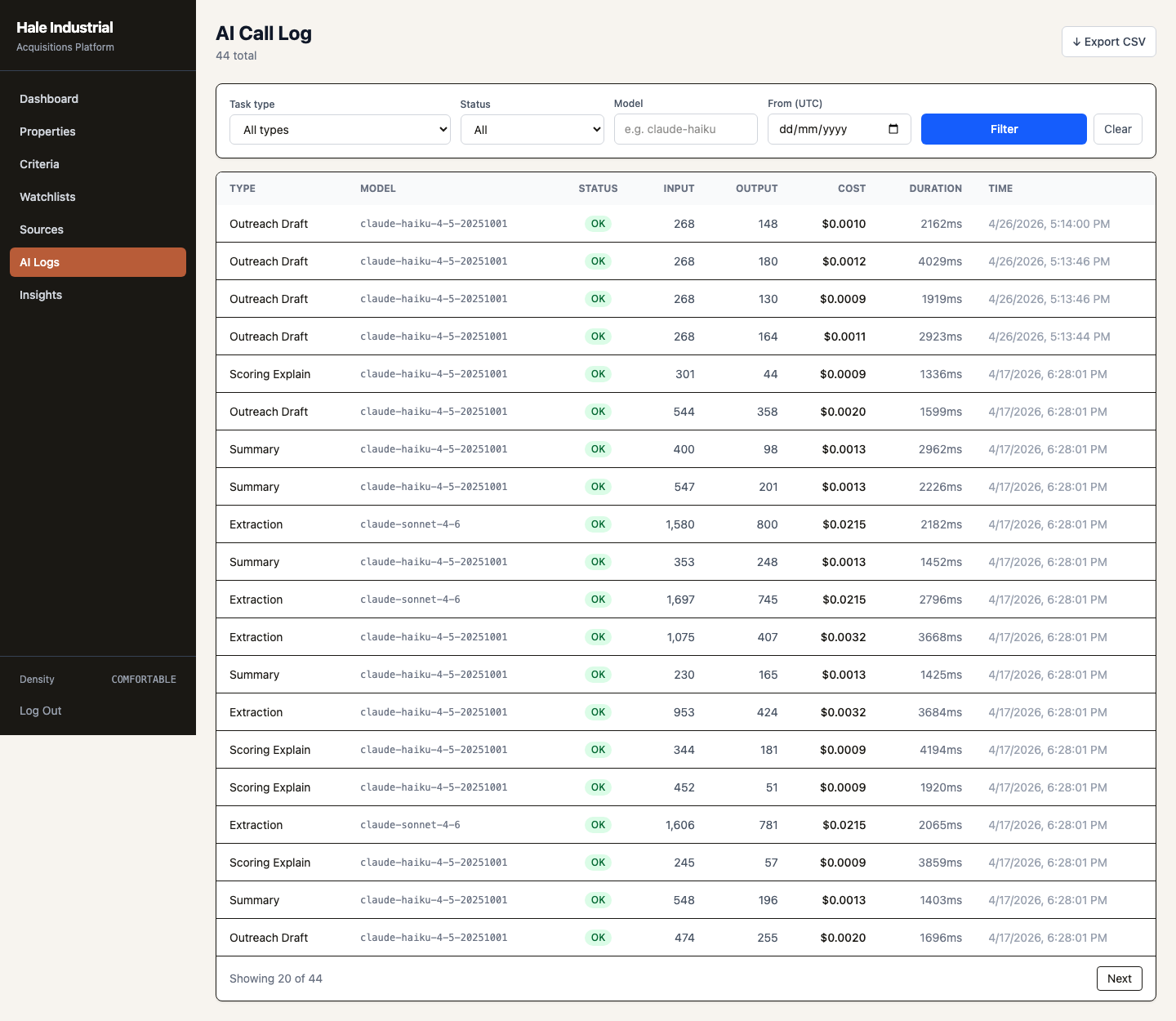
Per-tenant AI cost ceiling. Every Claude call is logged, and a daily spend cap is enforced before the API is hit. A bug in a prompt cannot burn more than the limit — currently $5/day per tenant. The audit log is immutable and exportable as CSV for finance.
Transparent math. Scoring factors, weights, and per-factor scores are all visible. No learned weights. No "proprietary algorithm." You can see why every property landed where it did.
Multi-tenant from day one. Architected to host additional tenants even while deployed as a single-client app. Future growth doesn't require a rewrite.
Three shipping gates. Prototype (clickable UX + fake data, before any backend), MVP (the real app with rough edges, usable for real work), Launch (SOW complete, ownership transfers). Client signs off explicitly at each gate; scope stays honest.
What this case study is about
This is the first project we've shipped as an AI Workbench — a specific product category we've been working to name. A workbench isn't an AI agent (too autonomous), isn't an AI copilot (too ambient), and isn't vertical AI SaaS (too commercial at day zero). It's a workflow tool for one specialist role, built on a shape we've seen come up repeatedly in the hiring market. Hale is the canonical example.
If your team has a specialist — an analyst, a document reviewer, a recruiter, an ops lead — whose day is getting swallowed by tedious reading and drafting, and whose judgment still has to be in the loop on every decision, we can build you a workbench too.
More from this project