Drystack Brief: A Paid Newsletter for the Independent Hospitality Trade
A solo-operated paid newsletter built on owned infrastructure — sponsor decks, paid archive, and a marketing toolkit that lets one editor produce twice the output without burning out.
This is a fictional brand UWC built to demonstrate what we ship for real founders. The pipeline, agents, and screenshots are real; the business is illustrative.
The Challenge
An independent journalist with two decades on the hospitality beat had built the largest insider list for owner-operators of restaurants, bars, and boutique hotels — 6,500 paid subscribers at $14/mo. The list lived on a shared platform that took 9% of revenue, owned the analytics, and made sponsor deals impossible to template. Issue production was manual: write, format, schedule, post on social, update the sponsor deck, send. Each issue cost half a day of work outside the writing itself.
Our Approach
We built Drystack on the same Astro + Cloudflare stack we use for our other clients, with a custom Stripe-backed paid tier and a marketing dashboard built for solo operation. Issues publish to a public preview with a paid gate after the first three paragraphs. The archive is fully indexed and Stripe-aware. The marketing dashboard handles social scheduling to LinkedIn and Instagram, drafts the sponsor deck from issue performance, and surfaces open + click + churn signals in one weekly readout. The editor writes; the toolkit runs everything else.
Key Results
Services Provided
Portfolio Demo — Drystack Brief is a fictional business created by Upstate Web Co. for portfolio purposes. All names, subscriber counts, revenue figures, and quotes are illustrative. The real product, infrastructure, and toolkit shown are the same ones we ship to working clients.
The situation
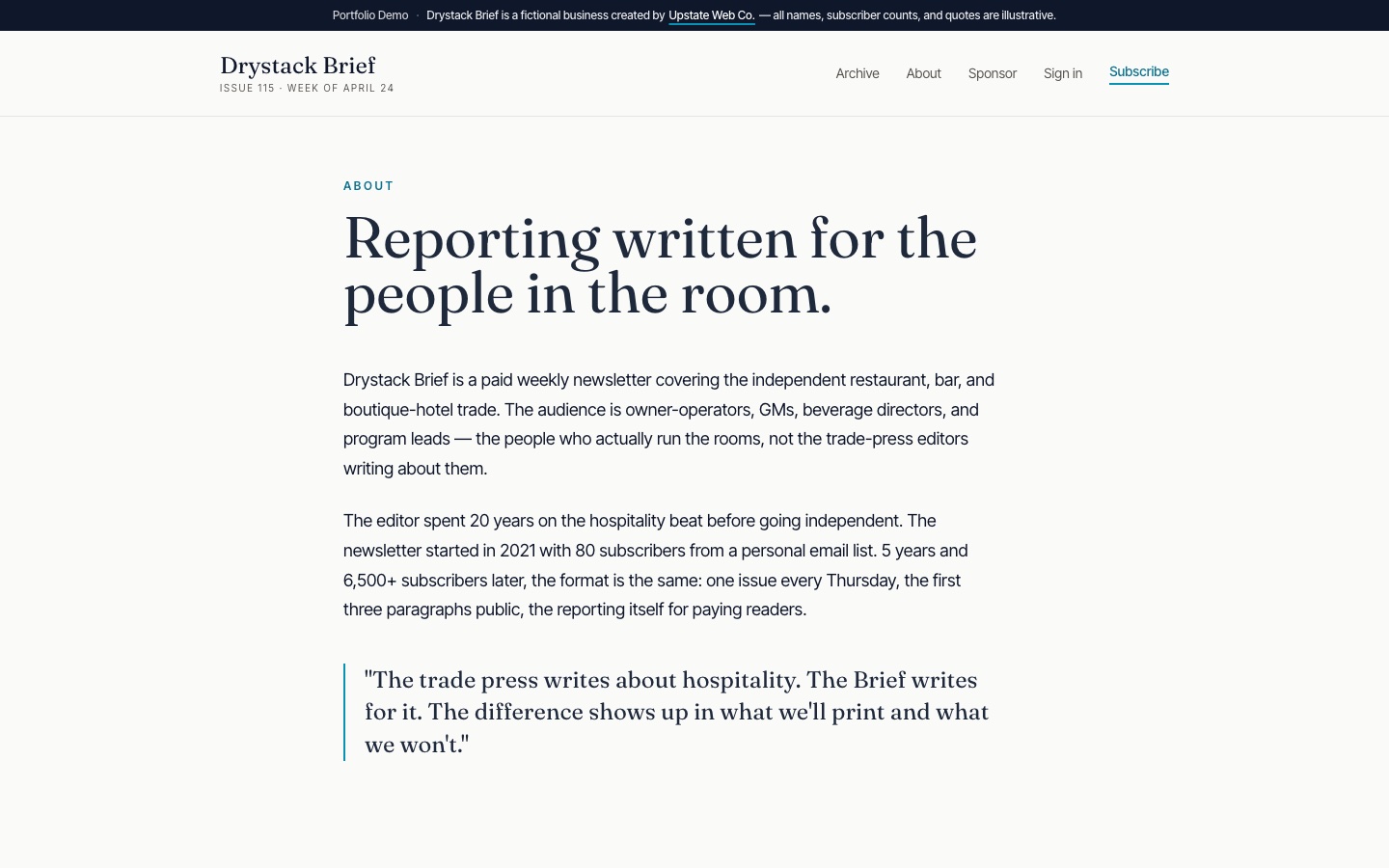
The independent hospitality trade — chefs running their own places, bar program directors, boutique-hotel operators, the people who actually run the rooms — has always been an oral-tradition industry. Big trade media exists, but the sharp insider takes happen in private DMs and at industry events.
The editor who founded Drystack spent twenty years on that beat. Substack let her start the newsletter quickly. Five years in, she had 6,500 paid subscribers, $1.1M ARR, and a problem: the platform took 9% of revenue, controlled the analytics, and made it nearly impossible to package sponsorships against per-issue performance. Sponsors wanted dashboards; the platform gave her a CSV.
She also had no leverage on production. Each issue meant: write the piece, format it, schedule the post, write three social-media versions, copy-paste the latest stats into the sponsor deck, send. Half a day of operational work surrounding maybe three hours of actual writing.
What we built
A custom site on the same stack we use for every UWC project — Astro on Cloudflare Pages, Stripe-backed paid subscriptions on her own account, full ownership of the list and the data. Three things made the difference:
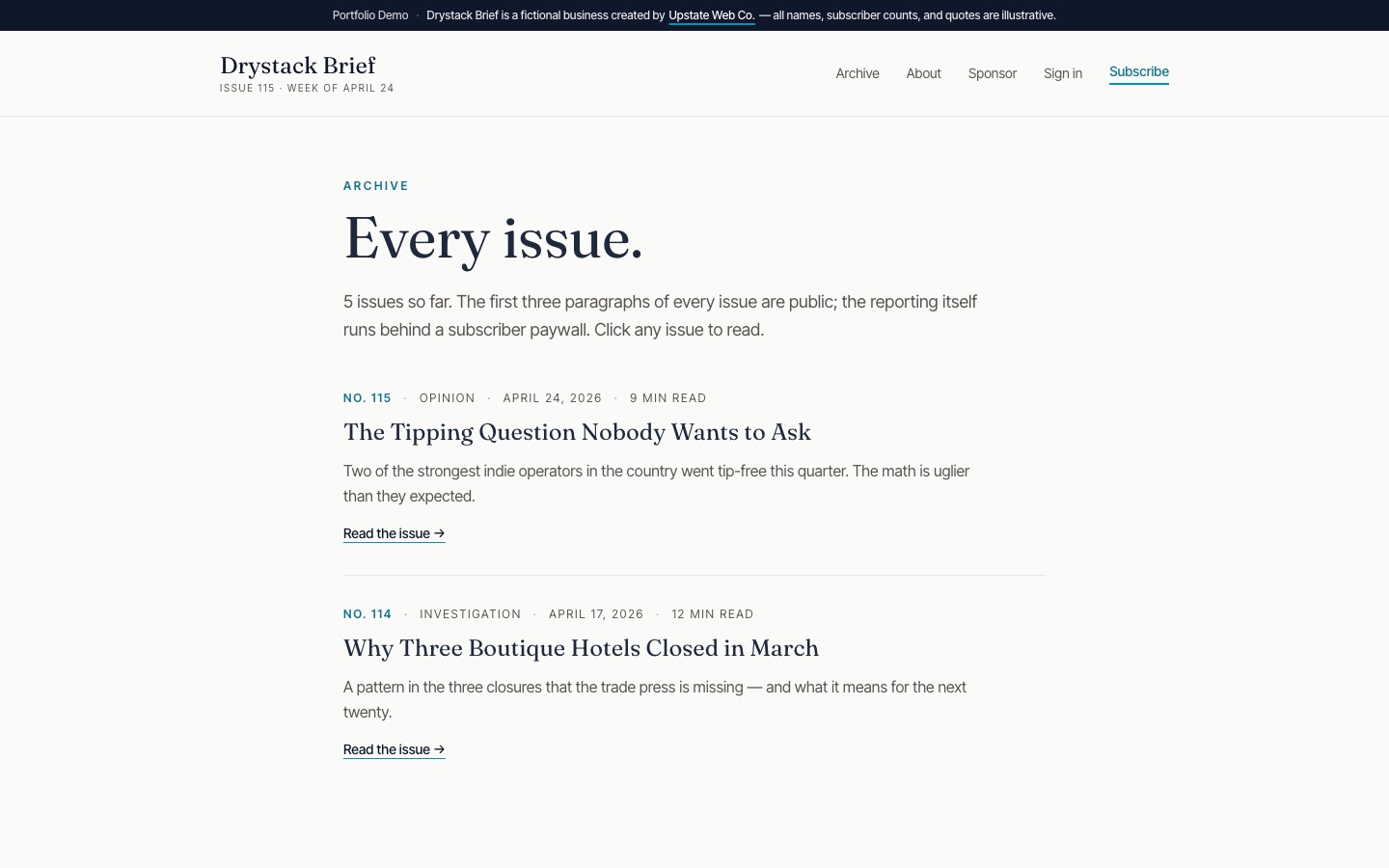
A paid-archive that respects the reader. The first three paragraphs of every issue are public and Google-indexed. After that, a soft paywall. Search-driven discovery brings new subscribers in without giving away the depth.
A sponsor kit that writes itself. Per-issue open rates, click-throughs, and reader segmentation feed a templated sponsor deck. Sales cycle that used to take a week of slide formatting now takes thirty minutes of review.
A marketing dashboard the editor actually uses. Issue announcements draft themselves on LinkedIn and Instagram; she approves before they publish. List health, churn signals, and acquisition channel breakdowns surface in one weekly readout. No more switching between five tools to ask one question.
How we work with her team
The editor works with a part-time researcher and a freelance proofreader. Both log into the workspace under their own accounts — the researcher schedules teaser posts the day before each issue, the proofreader drops final-pass corrections directly into the draft. UWC operates the platform; the editor and her team make every editorial call.
What's running on retainer
Growth Partner ($400/mo): the marketing dashboard runs in the background, drafts get queued, the sponsor deck refreshes itself. UWC handles platform updates and any infrastructure work. The editor never thinks about hosting, payments, or analytics integrations again.
How this build was validated (UWC pipeline run)
Drystack Brief is a fictional persona, but the build went through the same pipeline a real client project does:
Intake → AI scoring. The persona's project description was scored by SYSTEM_PROMPTS.leadScoring — Hot, Business tier, $3.2K–$4.8K estimated. Hot leads auto-convert to a project record without admin click.
Brand questionnaire (Rule 73 inputs). Five reference URLs (Stratechery, FT, Lenny's Newsletter, The Atlantic, Bloomberg) plus two anti-references (UWC's own marketing site, Eater) plus ambition (editorial_confident), look-and-feel (refined), surface (website), and business type (media_publisher).
Reference signature extraction. Each of the seven URLs was fetched + sent through SYSTEM_PROMPTS.referenceSignatureExtractor — a structured 47-dim breakdown of typography, palette, motion, layout, and ambition. Six of seven extracted cleanly (Stratechery served HTTP 403 to the bot UA — typical, doesn't block downstream).
3 design-direction candidates generated. The picked-direction prompt returned three legitimately distinct briefs:
- A. Editorial Confident — Fraunces + Inter Tight · Editorial Slate (#1E293B + #0891B2 cyan) · Text-First Editorial layout · Restrained Editorial motion. Anti-commitment: "NOT magazine-glossy consumer media with image-heavy layouts and decorative typography."
- B. Editorial Authority — Tiempos Text + IBM Plex Sans · Trade Press Charcoal · Article-Led Archive · Functional Minimal motion.
- C. Trade Publication — Spectral + Söhne · Newsprint Warmth · Full-Bleed Pivot · Scroll-Linked Reveals.
Each picks a different typography pairing, palette, and layout — not three variants of the same direction.
Direction A picked. Reasons: (a) Fraunces is fundamentally distinct from UWC's DM Serif signature so the demo doesn't read as a UWC sibling; (b) the cyan accent lives in a different palette family from UWC's earth-tones (rust/saffron/ochre); (c) "Text-First Editorial" matches the Stratechery + FT extracted patterns; (d) anti-commitment matches the persona's voice.
Build + visual-diff scoring. The deployed site (phase-a-build.drystack-brief.pages.dev) was scored by Ghost User against the picked direction. Verdict: 9/10 pass. Quote from the report: "MATCHES PICKED DIRECTION. Fraunces is present in hero, article titles, section headings, and footer. Inter Tight is the body/UI font. Industry fit: serif display + geometric sans body is the signature of trade authority (FT, WSJ, The Information). Consumer food media uses sans headlines or decorative scripts — this site's typography screams primary source reporting, not listicle."
Pipeline artifacts persisted. The lead, the client, the project, the discovery → design → build → review phases, the brand questionnaire (with all Rule 73 inputs), the seven reference signatures, the three direction candidates, the picked direction, and the visual-diff agent report all live in the same admin D1 a real client project would.
This is what UWC means by toolmaker discipline: the same pipeline runs whether the persona is real or fictional, and every step leaves a verifiable record.
Post-governance sharpening (2026-04-28)
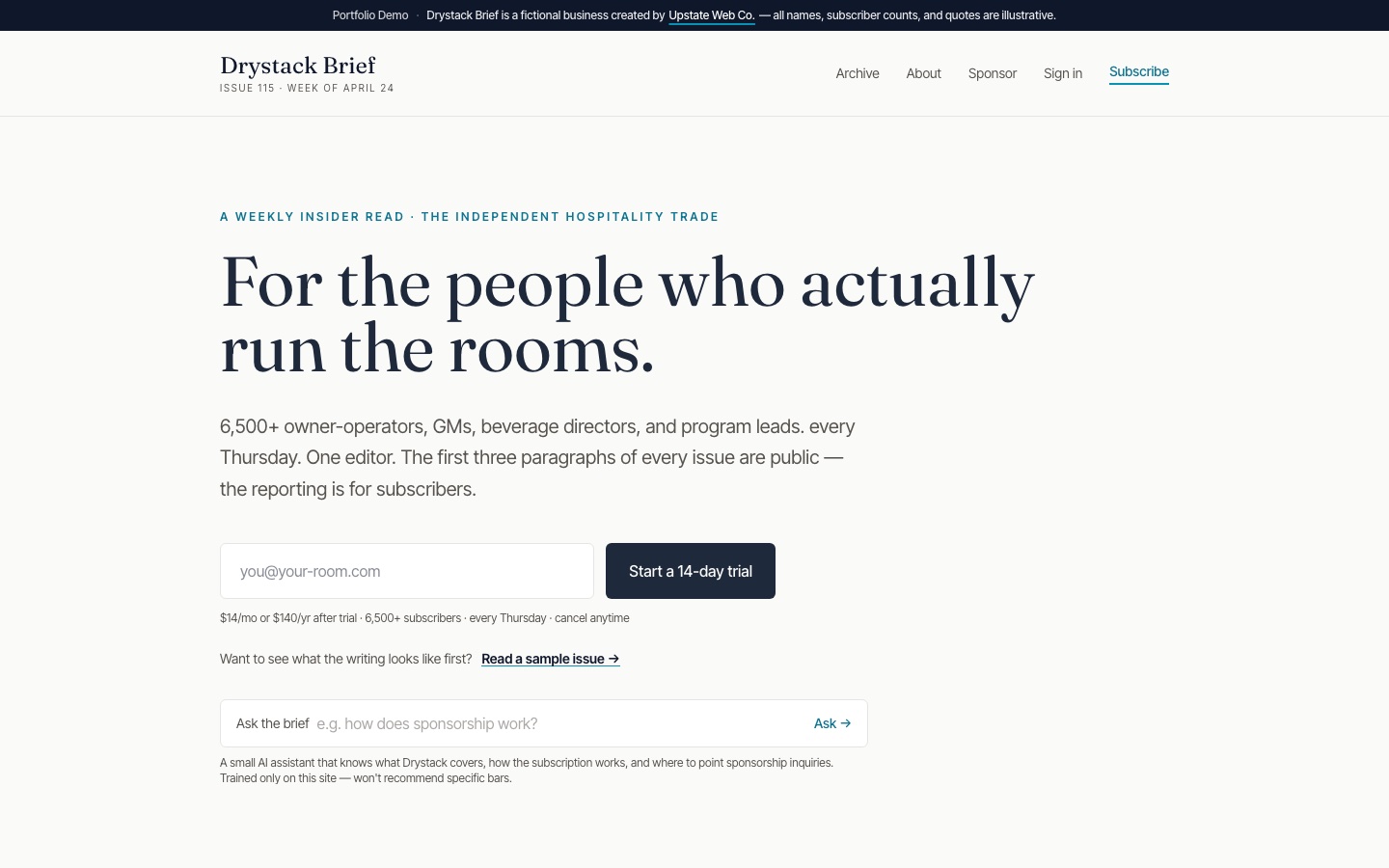
Ran a post-build governance pass on the deployed site. The synthesis flagged that prospects could not preview a real article before committing $14/mo — the "first three paragraphs public" promise was load-bearing copy with no visible proof on the homepage. Added a "Read a sample issue →" link in the hero pointing at /issue/no-115-the-tipping-question (Issue 115, "The Tipping Question," already prerendered with public preview + paywall). The article was always there; the path to it was not. Re-deployed; the camera now has a real article page to land on for the marketing-video shoot.
"The platform was eating my margin and owning my list. UWC built me a stack that cost less per month than what I was paying in fees per week. I write the issue. Everything else just runs."
More from this project